ASNC Releases New Guideline for Stress Testing in SPECT and PET Myocardial Perfusion Imaging
Updated recommendations address patient preparation, stressor selection, safety, modality-specific protocols, interpretation, reporting and laboratory supervision
FAIRFAX, VIRGINIA, USA (September 8, 2026) – The American Society of Nuclear Cardiology (ASNC) today announced release of the “2026 ASNC Guideline for Stress Testing in Single-Photon Emission Computed Tomography (SPECT) and Positron Emission Tomography (PET) Myocardial Perfusion Imaging.”
Published online in the Journal of Nuclear Cardiology, the new guideline provides practical, beginning-to-end guidance for cardiac stress testing, including patient selection and preparation, exercise and pharmacologic stress protocols, safety considerations, result interpretation, reporting and laboratory supervision.
Cardiac stress testing with SPECT or PET myocardial perfusion imaging is a well-established, noninvasive tool used to diagnose, assess risk and guide the management of patients with suspected or known heart disease. The tests are performed widely in both inpatient and outpatient settings.
The guideline updates the stress-testing components of ASNC’s 2016 guidance and reflects important changes in nuclear cardiology practice over the past decade. While SPECT remains a cornerstone of myocardial perfusion imaging, PET has assumed an increasingly prominent role because of advances in imaging technology, broader access to PET/CT systems, growing clinical evidence and the availability of new imaging options.
“This updated clinical guideline is intended to serve as a single source of information for all aspects of stress testing — a comprehensive reference for exercise and pharmacologic stress,” says Lane Duvall, MD, MASNC, chair and lead author of the guideline. “The guideline provides what clinicians need for the preparation, performance, interpretation and reporting of stress testing.”
Key Updates in the 2026 Guideline
The guideline includes several changes intended to enhance the safety, accuracy and consistency of cardiac stress testing:
- Detailed SPECT- and PET-specific protocols, including guidance on exercise PET, modality-specific instructions for individual stressors, radiotracer timing and myocardial blood flow assessment
- Updated patient preparation recommendations, including caffeine avoidance, breastfeeding, medication management and patient pre-test instructions
- Expanded safety guidance, with updated contraindications and “cautionary conditions,” new recommendations for patients with seizure risk, indications for early termination of testing and an individualized approach to choosing or changing the stress testing method
- New standards for interpretation and reporting, including exercise capacity, symptoms, ECG findings as well as heart rate and blood-pressure responses
- New guidance on staffing and laboratory operations, including training and competencies, supervision and physician oversight, emergency preparedness and quality improvement
- Discussion of emerging approaches, such as cold pressor and mental stress testing
The recommendations apply to adult stress testing in inpatient and outpatient settings and are intended for the multidisciplinary teams that order, perform, interpret and oversee SPECT and/or PET myocardial perfusion imaging. They allow protocols to be adapted to individual patient needs and local resources.
“Cardiac stress testing is performed across a wide range of patients, clinical settings and laboratory environments,” Dr. Duvall says. “By bringing patient preparation, stress protocols, safety, interpretation and supervision together in one document, we hope to support consistency and high-quality patient care across nuclear cardiology laboratories.”
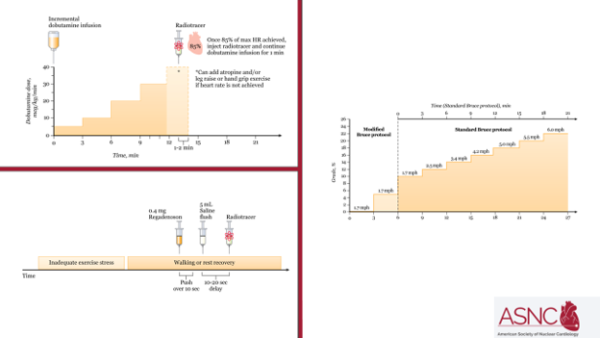
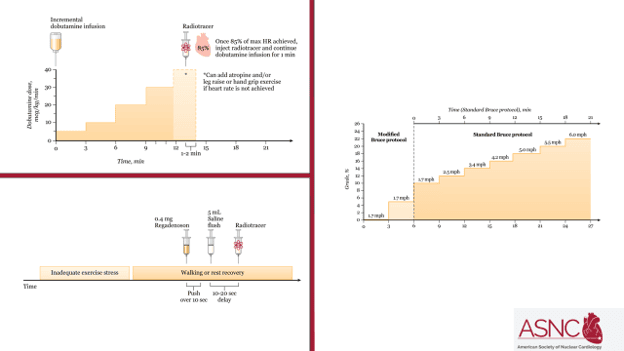
The 2026 ASNC Guideline for Stress Testing in Single-Photon Emission Computed Tomography (SPECT) and Positron Emission Tomography (PET) Myocardial Perfusion Imaging features step-by-step instructions for performing stress testing with all available stress agents, including easy-to-understand graphics/protocols. Top left: Dobutamine protocol. Right: Standard and Modified Bruce protocols. Bottom left: Regadenoson in recovery after inadequate exercise stress test.
The guideline was developed by a multidisciplinary ASNC writing committee following an extensive review of the published literature. Recommendations were based on available scientific evidence and expert consensus and underwent external peer review before final approval. Dr. Duvall served as chair and lead author of the writing committee; Hicham Skali, MD, MSc, FASNC, as co-chair; and Milena J. Henzlova, MD, PhD, MASNC, as senior author.
The Article-in-Press is available from the Journal of Nuclear Cardiology.
###
About ASNC
The American Society of Nuclear Cardiology is the international home for nuclear cardiology and the largest professional society devoted exclusively to the field. ASNC’s membership includes more than 5,900 nuclear cardiology professionals from around the world. Founded in 1993, ASNC’s mission is to improve cardiovascular outcomes through image-guided patient management. ASNC establishes standards for excellence in cardiovascular imaging through the development of clinical guidelines, professional medical education, advocacy, and research. ASNC’s official publication is the Journal of Nuclear Cardiology.
Article Type
JNC News, Press Release
Category
Guidelines & Quality, Journal of Nuclear Cardiology (JNC), Publications, Technologist, Trainee
Related Posts
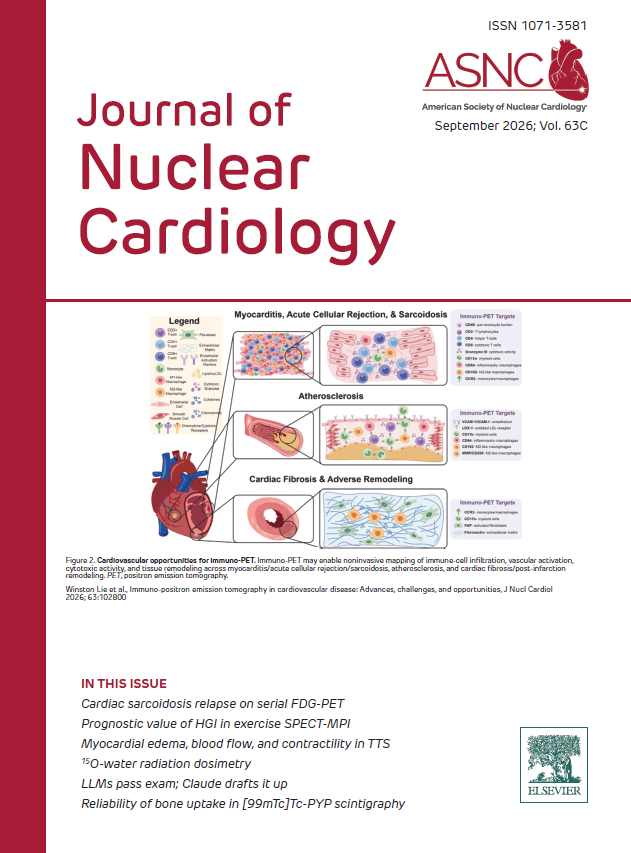
JNC Showcases Quantitative Advances Driving Progress Across Nuclear Cardiology
From refining radiation dosimetry to improving risk prediction and expanding molecular imaging…

A Practical Update for the Stress Lab: Q&A With Guideline Chair Dr. W. Lane Duvall
“I think clinicians reviewing the guideline will have a number of small…

Announcing This Year’s Journal of Nuclear Cardiology Awardees
ASNC joins Journal of Nuclear Cardiology Editor-in-Chief Marcelo F. Di Carli, MD,…