
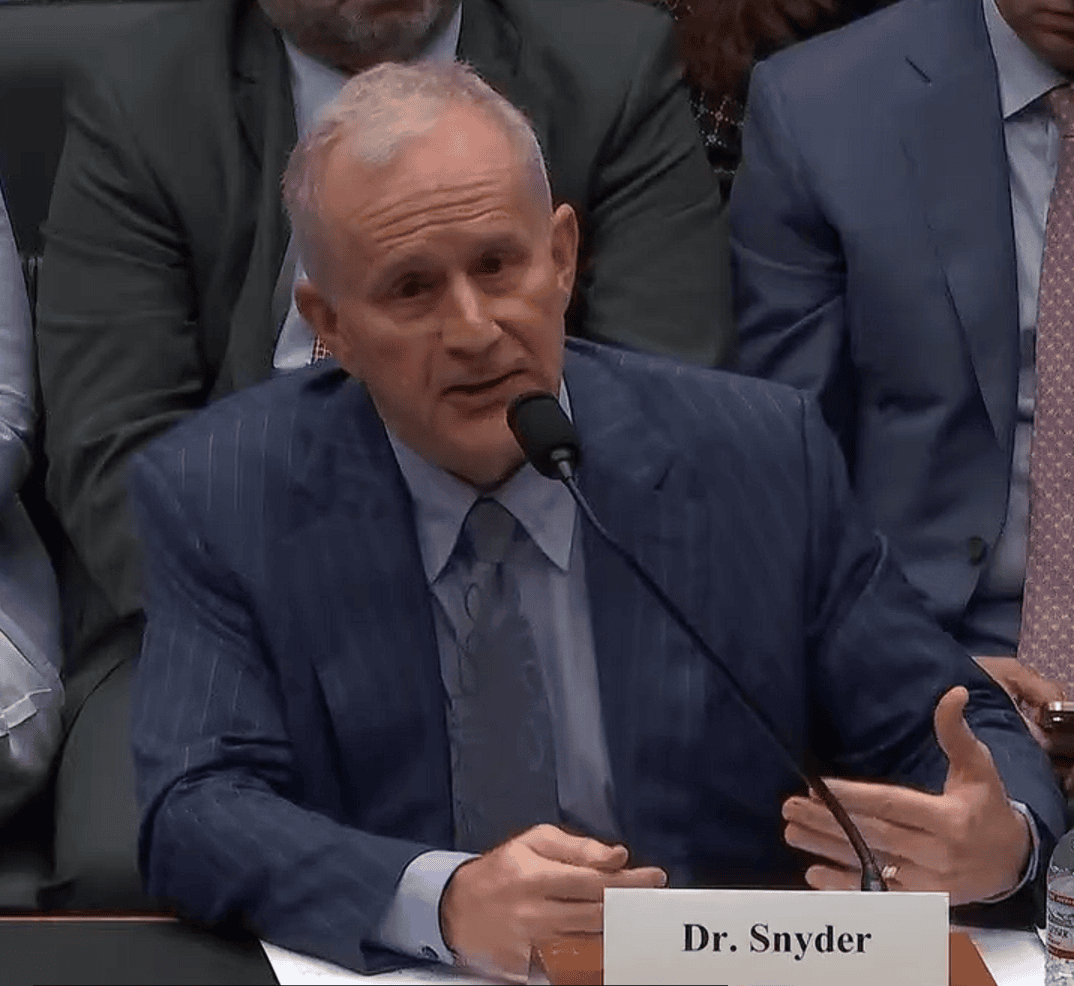
Rick Snyder, MD, interventional cardiologist from Texas, spoke before Congress on the value of cardiac PET. Watch Now.
“[Cardiac PET] gives us very good data, probably the most accurate, about whether a patient has an obstructive blockage or not … [PET] is also the only noninvasive test available to actually detect [microvascular dysfunction.]”
– Rick Snyder, MD,
testifying at the May 20 House Energy and Commerce Subcommittee on Health Hearing
At a congressional hearing convened last week by the House Energy and Commerce Subcommittee on Health, interventional cardiologist Rick Snyder, MD, explained to lawmakers the benefits of cardiac PET for diagnosing both obstructive and microvascular coronary artery disease.
Speaking on behalf of the American Independent Medical Practice Association, Dr. Snyder said cardiac PET “is a very powerful tool,” valuable for its accuracy, high-quality images, low radiation, and for assessing coronary flow reserve. He emphasized that PET is the only noninvasive test for detecting microvascular dysfunction, which he said is common in women and disproportionately prevalent in African Americans.

ASNC’s New York Advocacy Delegation met with legislative staff for Rep. Nick Langworthy on May 5. From left: Suman Tandon, MD, FASNC, Robert Mendelson, MD, Andrew J. Einstein, MD, PhD, MASNC, and Bruce Decter, MD, FASNC.
Asked by Rep. Nick Langworthy (R-NY) how important it is for physician payment policies to keep pace with new technologies, Dr. Snyder said cardiac PET “actually saves us money” because “we’re able to defer the more costly invasive procedures … and not expose the patient to an invasive procedure.”
Urging Action on Payment Reform
Every single physician who testified at the Subcommittee hearing asked Congress to provide an inflationary update to the Medicare physician fee schedule. When they were polled by Rep. Raul Ruiz, MD (D-CA), the physicians unanimously agreed that passage of H.R. 6160, the Strengthening Medicare for Patients and Providers Act, should be an important priority for congressional action. ASNC also supports H.R. 6160, which would provide physicians with an annual inflationary update by tying physician fee schedule rates to the Medicare Economic Index.
Opposing the ROOT Act’s AUC Mandate
As noted in ASNC’s May 19 alert to members, the Subcommittee’s hearing also included testimony from the American College of Radiology (ACR), whose CEO pushed for passage of H.R. 5737, the Radiology Outpatient Ordering Transmission Act (ROOT Act). We appreciate the efforts of members who used the ASNC Action Center to contact Congress on this important issue.
ASNC also led a delegation of cardiovascular societies on a letter to leaders of the GOP and Democratic Doctors Caucuses opposing the ACR proposal. The groups are recommending that reform of the Merit-based Incentive Payment System should be used to encourage appropriate resource use and delivery of high-value care not just in imaging, but rather across all services.
ASNC continues to urge members to ask lawmakers to oppose the ROOT Act, as the Centers for Medicare & Medicaid Services has already determined that a separate AUC consultation program is not the most effective way to address challenges of appropriate imaging use.
Article Type
News & Announcements
Category
Advocacy
Related Posts

ASNC Leader Appointed to U.S. Preventive Services Task Force
Venkatesh Murthy, MD, PhD, MASNC, has been appointed to the U.S. Preventive…
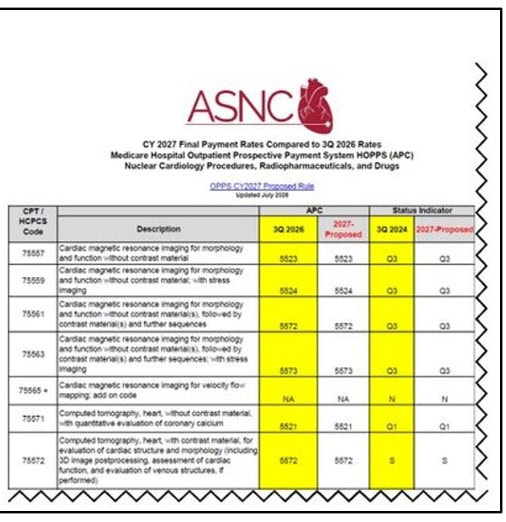
2027 HOPPS Proposed Rule Would Restructure Nuclear Medicine APCs, Could Affect Nuclear Cardiology Payment Rates
In the 2027 Hospital Outpatient Prospective Payment System (HOPPS) proposed rule, the…

Check Now! Are You on CMS’s Heart Failure Payment Model List?
“ASNC Members, it is critically important that you check the CMS website…