

On July 14, the Centers for Medicare & Medicaid Services (CMS) released the 2027 Medicare Physician Fee Schedule (MPFS) proposed rule. Your advocacy team is conducting a code-specific analysis of the rule and will report on specifics that may impact your practice as well as any actions ASNC will take.
Following is a top-line analysis of a few key proposals:
Conversion Factor
For 2027, and per statute, CMS’s proposed conversion factor varies depending on whether a physician is successfully participating in an Advanced Alternative Payment Model (AAPM). For both AAPM-qualified participants and non-AAPM participants, the proposed conversion factor is reduced as a result of the expiration of the 1-year increase of 2.5% provided by Congress for 2026.
The 2027 proposed conversion factor for physicians not participating in an AAPM is $32.84, which reflects a projected decrease of $0.56 (-1.68%) from the current conversion factor of $33.40.
For AAPM-qualified participants, the proposed 2027 conversion factor is $33.17, a decrease of $0.40 (-1.19%) from the current conversion factor of $33.57.
Medicare Physician Payment Policy
Practice Expense: CMS proposes to modify the practice expense (PE) relative value unit (RVU) methodology by removing the indirect practice cost index (IPCI) from the calculation of PE RVUs over a 2-year period. The IPCI is based on aggregate specialty-level practice costs derived from the American Medical Association’s 2007 Physician Practice Information Survey. CMS argues that by relying on the IPCI calculation under the current PE methodology, aggregate specialty-level survey data with low response rates are favored over code-level inputs. CMS also proposes a PE stabilization adjustment, which it states would mitigate short-term PE volatility without anchoring overall values to a specific point in time.
CMS maintains the indirect PE methodology for 2027 but is soliciting feedback on possible refinements, including specific data that account for variability in physician PE costs in facility and non-facility settings. The current policy reduces by half the amount of indirect PE RVUs per work RVU for services furnished in the facility setting compared to those allocated to services furnished in the non-facility setting. While nuclear cardiology imaging services were not specifically affected by the policy, it has an impact on cardiology services broadly.
RVU Transparency: CMS is signaling its interest in moving more aggressively to neutralizing payments across sites of care by posting a public use file that displays work and PE RVUs of services. The agency says this policy shift would improve transparency and illuminate differences in fees between technical aspects of MPFS services compared to facility fees.
Efficiency Adjustment: CMS maintains the efficiency adjustment that took effect this year and cut physician work intraservice time by 2.5% for all non-time-based services. As previously finalized, the efficiency adjustment will be recalculated and reapplied every 3 years.
Imaging Duplication and Interoperability
Ambulatory Specialty Model for Heart Failure
CMS is proposing technical modifications to the Ambulatory Specialty Model (ASM) for Heart Failure scheduled to begin Jan. 1, 2027, including adding 5 points to the final scores of ASM participants in rural areas.
ASMs are a mandatory program aimed at holding physicians accountable for the quality and cost of care associated with the management of specific chronic conditions, including heart failure. Physicians will be evaluated on 4 performance areas (quality, cost, improvement activities, and promoting interoperability) and will receive a positive, neutral, or negative payment adjustment between +9% and -9% based on their performance score.
CMS’s proposed changes to its ASM for heart failure seek to clarify how the model would function, although significant concerns with the program remain. As previously finalized, physicians with a specialty designation of “cardiology” would be required to participate, although cardiologists in highly specialized or procedure-focused practice areas (cardiac electrophysiology, intensive cardiac rehabilitation, cardiac surgery, interventional cardiology, and advanced heart failure and transplant) are excepted. There is ongoing concern about physicians being misattributed to the model as well as the performance metrics.
More Information Coming Soon
For more information on the 2027 Medicare Physician Fee Schedule proposed rule, refer to these resources:
- 2027 Medicare Physician Fee Schedule Proposed Rule
- 2027 Medicare Physician Fee Schedule Proposed Rule Fact Sheet
ASNC will soon complete its analysis of the proposed rule and will share details with ASNC members.
If you are not yet an ASNC member and want to receive advocacy updates, join ASNC or renew your membership now.
Article Type
News & Announcements
Category
Advocacy
Related Posts

ASNC Leader Appointed to U.S. Preventive Services Task Force
Venkatesh Murthy, MD, PhD, MASNC, has been appointed to the U.S. Preventive…
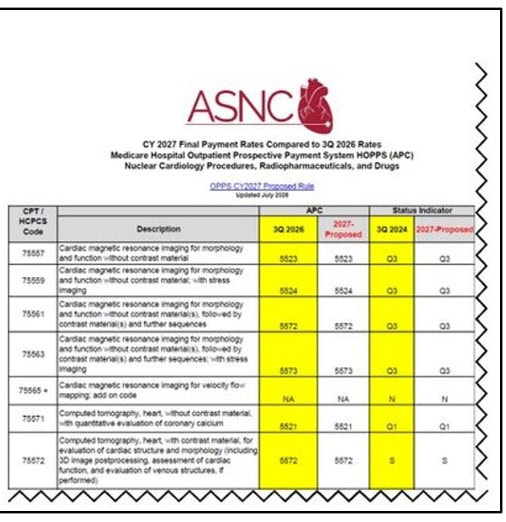
2027 HOPPS Proposed Rule Would Restructure Nuclear Medicine APCs, Could Affect Nuclear Cardiology Payment Rates
In the 2027 Hospital Outpatient Prospective Payment System (HOPPS) proposed rule, the…

Check Now! Are You on CMS’s Heart Failure Payment Model List?
“ASNC Members, it is critically important that you check the CMS website…