
For the October 2026 cardiac PET case poll, ASNC asked voters to choose the next management step for the featured patient – a 65-year-old woman with gallbladder cancer who was receiving chemotherapy and had declining left ventricular (LV) function. She underwent regadenoson F-18 flurpiridaz PET myocardial perfusion imaging (MPI), which showed stress and rest ejection fractions of 52% and 51%, respectively – similar to echocardiography. Her negative troponin and NT-proBNP were negative.
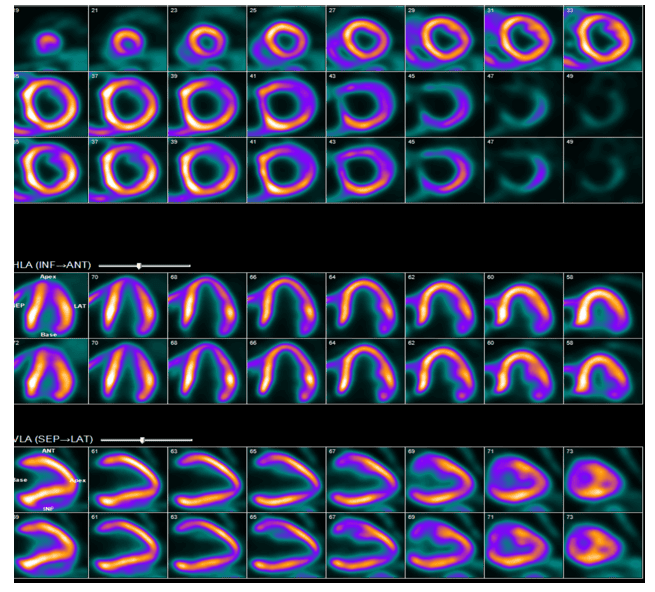
Relative perfusion images from the patient’s regadenoson F-18 flurpiridaz PET MPI study.
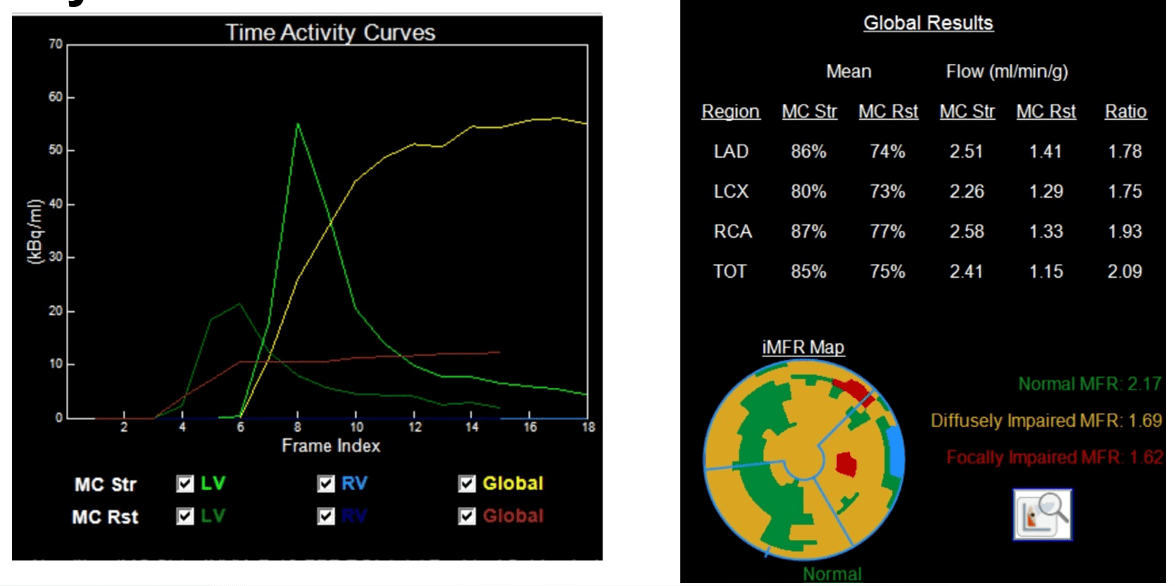
Myocardial blood flow findings from the patient’s regadenoson F-18 flurpiridaz PET MPI study.
Would You Recommend Continuing Chemotherapy?
Poll participants were shown relative perfusion images and myocardial blood flow data from the patient’s regadenoson F-18 flurpiridaz PET myocardial perfusion imaging. Half of the voters said they would recommend continuing chemotherapy. The remaining votes were divided across ordering invasive catheterization (22 percent), stopping chemotherapy (16 percent), and recommending steroids (13 percent).
 The case, authored by Abdelrahman Ali, MD, Tareq Abu Sharifeh, MD, and David Cardoza Ochoa, MD, of the Sealy Heart and Vascular Institute, University of Texas Medical Branch, highlights the role of cardiac PET in evaluating a challenging clinical scenario in a patient undergoing cancer treatment.
This case was discussed in some detail on LinkedIn.
Do you have an interesting cardiac PET case to share? Contact Linda Giering at lgiering@ASNC.org.
Article Type
News & Announcements
Category
Education
Related Posts

JNC Editor Challenges Nuclear Cardiology Community to Advance Inflammation Imaging and Clinical Evidence
Advancing molecular imaging of myocardial inflammation will require a concerted effort from…
Cardiac Amyloidosis and Suspected Coronary Disease: What Would You Do Next?
An 80-year-old man with chest pain and known ATTR cardiac amyloidosis, diagnosed…

CMS Releases Final Medicare Physician Fee Schedule and Hospital Outpatient Payment Rates and Policies for 2027
The Centers for Medicare & Medicaid Services (CMS) has released the 2027…