


From left: Yufan Gu, MD, and Lei Wang, MD, are, respectively, the first and senior authors of the JNC article Preclinical and First-in-Human Studies of a Novel Tracer for Single-Photon Emission Computed Tomography Myocardial Blood Flow Quantification.
There’s a new perfusion radiotracer on the horizon, and it has the potential to bring the power of myocardial blood flow quantification to “every SPECT lab on earth,” says Journal of Nuclear Cardiology Editor-in-Chief Marcelo F. Di Carli, MD, MASNC. “The tracer, 4-BOH, shows on every model high extraction, high retention, and most importantly, very close correlation with tracers that we are using clinically, like N-13 ammonia, for quantification of myocardial blood flow. Plus, the images look really spectacular.”
4-BOH is the result of decades of compound synthesis and evaluation by investigators who saw past the “fatal flaws” in teboroxime, a tracer that earned FDA approval in the 1990s but never made it into clinical practice, says Lei Wang, MD, senior author of the JNC article Preclinical and First-in-Human Studies of a Novel Tracer for Single-Photon Emission Computed Tomography Myocardial Blood Flow Quantification.
As guests on Episode 11 of the JNC CardioConnect podcast, Dr. Wang and the study’s first author, Yufan Gu, MD, explain why the animal and human validation studies performed on 4-BOH give them “a lot of confidence moving into imaging studies.” They are planning a noninferiority clinical trial to explore the tracer’s diagnostic performance.
“This is innovation within reach … precisely the kind of innovation we should be championing,” says ASNC President Panithaya Chareonthaitawee, MD, MASNC, on the podcast. “It is science that makes precision imaging more accessible, … bringing every tool we have to deliver precise, equitable, and impactful imaging for every patient, everywhere.”
Article Type
JNC News, News & Announcements
Category
Journal of Nuclear Cardiology (JNC), Research
Related Posts

More HMDP Coming in Late March, Radiopharmaceutical Manufacturer Says
Following supply issues starting in January, ASNC is maintaining close contact with…
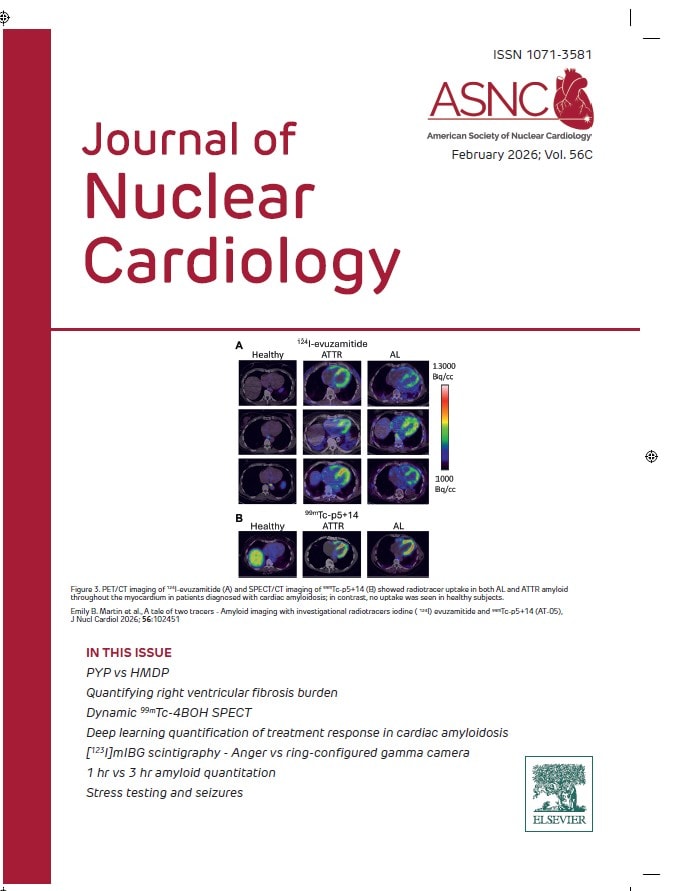
JNC Editor: SPECT’s ‘New Phase’ Will Expand What Nuclear Cardiologists Can Do Everywhere
“The collection of studies in this issue suggests that rather than fading…

Immediate Impact! ASNC Statement Driving Cardiac PET Adoption Across the United States
“ASNC’s Clinical Indications for PET statement got the attention of our hospital…