
 “Based on the clinical and scientific evidence now available, there are no clinical scenarios or patient subgroups where cardiac PET with myocardial blood flow should be excluded.”
Timothy Bateman, MD, MASNC
Lead Author of Clinical Indications for PET Myocardial Perfusion Imaging and Myocardial Blood Flow Quantification
Today, ASNC issued a position statement recommending that cardiac PET, if available, should be used to evaluate all patients with suspected coronary artery disease (CAD) who are candidates for myocardial perfusion imaging (MPI).
The new statement significantly expands ASNC’s 2016 recommendations, which listed specific scenarios where PET MPI should be favored. In the intervening 10 years, the scientific evidence base, worldwide clinical experience, and mainstream multisocietal guidelines have affirmed that cardiac PET MPI provides significant clinical advantages, including –
- High diagnostic accuracy;
- Powerful risk stratification;
- Robust, reproducible myocardial blood flow quantification, which supports recognition of coronary microvascular disease and confirms the effectiveness of stress when performed pharmacologically;
- Equitable value across diverse patient populations;
- Rapid acquisitions;
- Low radiation exposure; and
- Excellent image quality.
The statement also emphasizes the value of PET/CT for identification of important anatomic findings, such as coronary calcium. PET MPI with myocardial blood flow has significant strengths that make it ideal for CAD evaluation and provides for more informed decision-making.
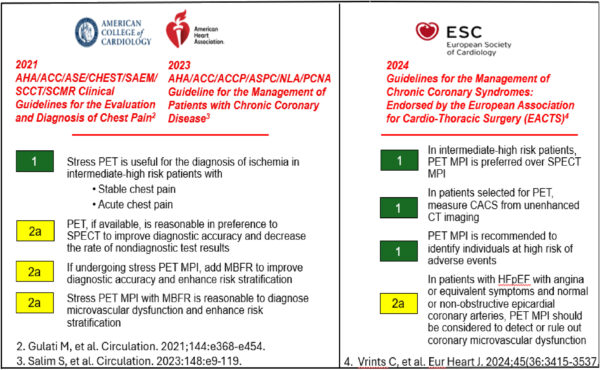
Recommendations for PET MPI in major US and European cardiology guidelines.2-4 Green box = class 1 recommendation. Yellow box = class 2a recommendation. From Clinical Indications for PET Myocardial Perfusion Imaging and Myocardial Blood Flow Quantification: An American Society of Nuclear Cardiology (ASNC) Position Statement.
“Based on the massive amount of clinical and scientific information now available and the latest U.S. and European guidelines, ASNC now recommends that PET MPI with myocardial blood flow, if available, should be the preferred modality for patients who meet criteria for MPI,” says ASNC Past President Timothy Bateman, MD, MASNC, lead author of the position statement. “There are no clinical scenarios or patient subgroups where cardiac PET with myocardial blood flow should be excluded.”
Addressing Prior Authorization Challenges, Expanding Access to Cardiac PET
Published in the Journal of Nuclear Cardiology, the new position statement will encourage further utilization of cardiac PET and myocardial blood flow quantification in the U.S. and around the world. Especially when paired with ASNC’s PET Model Coverage Policy, the statement is a valuable tool for minimizing delays and denials caused by insurers’ prior authorization policies.
“In the past, insurers’ policies have too often denied cardiac PET testing unless patients met certain restrictive clinical characteristics,” says ASNC President Jamieson M. Bourque, MD, MHS, FASNC. “That ends now. This statement confirms that all patients undergoing perfusion imaging are best served by cardiac PET with myocardial blood flow, if available. This is an important step toward ensuring patients have access to the best test.”
Article Type
News & Announcements
Category
Advocacy, Guidelines & Quality, Journal of Nuclear Cardiology (JNC), Prior authorization, Publications
Related Posts

More HMDP Coming in Late March, Radiopharmaceutical Manufacturer Says
Following supply issues starting in January, ASNC is maintaining close contact with…
JNC Editor: SPECT’s ‘New Phase’ Will Expand What Nuclear Cardiologists Can Do Everywhere
“The collection of studies in this issue suggests that rather than fading…

CMS Names Physicians Required to Participate in New Heart Failure Payment Model
The Centers for Medicare & Medicaid Services (CMS) has released a searchable…